Open Government Partnership
Promoting transparency, accountability, and citizen participation in government
OGP Global
The Open Government Partnership (OGP) is a multilateral partnership that aims to secure concrete commitments from national governments to promote open government, active citizen participation, transparency, accountability, and the harnessing of new technologies to strengthen governance. This initiative started in 2011 and includes national governments, the private sector, and civil society organizations (CSOs) working together to co-create action plans with concrete commitments across various thematic areas.
Who is in OGP?
The Open Government Partnership (OGP) includes 75 countries and 150 local governments, representing more than two billion people, and thousands of civil society organizations. These national governments and local jurisdictions work alongside thousands of civil society organizations to co-create two-year action plans. Each member submits a plan co-created with civil society that outlines concrete commitments to enhance transparency, accountability, and public participation in government.
How Does OGP Work?
The OGP is based on the idea that civil society and government co-create action plans with concrete commitments. These commitments are then credibly implemented with support from partner organizations either within the member country or globally. The process begins when a state endorses the Open Government Declaration, signaling its commitment to transparency, access to information, and civic participation. Action plans are co-created with civil society to improve services and enhance people's lives, with progress openly reported.
When Did Malawi Join OGP?
Malawi has been a member of the OGP Global Body since 2013. Through OGP, Malawi embraces democratic values by promoting its constitutional principles of transparency, accountability, and citizen engagement. OGP in Malawi is a partnership among Government, Civil Society Organizations, and the Private Sector.
How Is OGP Working in Malawi
1. National Steering Committee
OGP in Malawi is coordinated by a National Steering Committee that leads the implementation of the Malawi OGP 2025–2028 National Action Plan. The committee includes government and civil society representatives who collaboratively guide implementation across sectors. The National Steering Committee provides oversight and support to government agencies, civil society organizations, and private sector stakeholders in fulfilling the commitments outlined in the action plan.
OGP Malawi National Steering Committee Membership
Government Institutions
- Ministry of Justice
- National Assembly
- Office of the President and Cabinet
- Malawi Human Rights Commission
- Anti-Corruption Bureau
- Ministry of Finance and Economic Affairs
- National Planning Commission
- Office of the Ombudsman
- Financial Intelligence Authority
Civil Society Organizations
- Council for Non-Governmental Organizations
- Malawi Economic Justice Network
- Federation of Disability Organisations in Malawi (FEDOMA)
- Malawi Internet Service Providers' Association (MISPA)
- The Public Affairs Committee (PAC)
- NGO Gender Coordination Network (NGOGCN
- CSO Network
- Section30
- Catholic Commission for Justice and Peace (CCJP
Ex-Officio Members
- Foreign & Commonwealth Development Office
- Adam Smith International
- World Bank
- European Union
2. Malawi National Action Plan
The Malawi OGP National Action Plan 2023–2025 outlines the country's commitments toward transparency, accountability, and citizen engagement. It was developed collaboratively with input from government and civil society.
Comprehensive plan outlining Malawi's open government commitments.
3. Secretariat
The Secretariat provides administrative and technical support to the OGP Malawi initiative, coordinating activities between government agencies, civil society organizations, and other stakeholders. It facilitates communication, organizes meetings, and ensures smooth implementation of the National Action Plan.
Supporting implementation of OGP commitments through coordination and administrative support.
4. Technical Working Groups
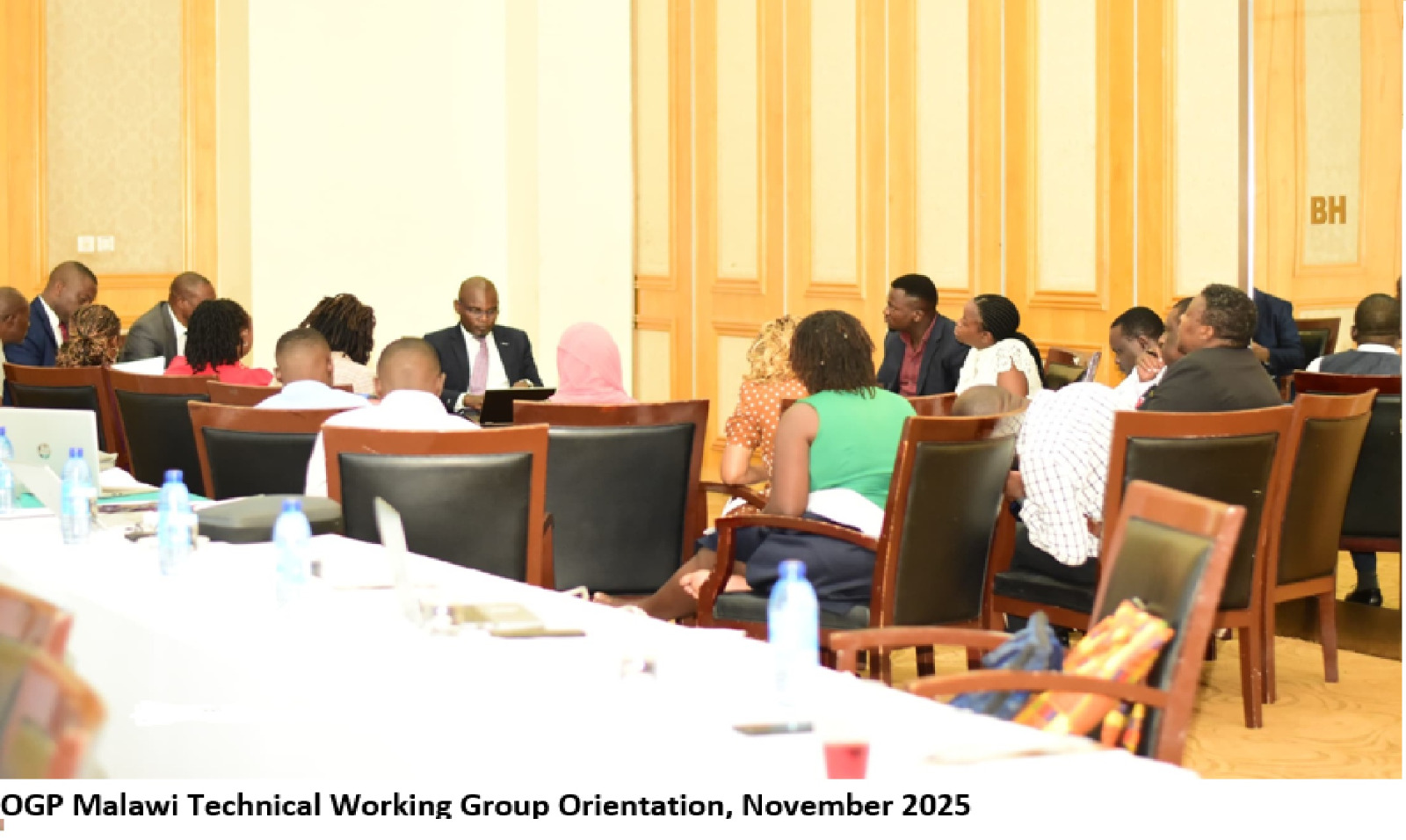
Technical Working Groups (TWGs) are formed to coordinate and track progress on specific commitment areas within the action plan. These groups consist of representatives from government ministries, civil society, and technical experts who meet regularly to review progress and provide implementation support.
-
1. Anti-Corruption
-
2. Climate and Enviroment
-
3. Digital Governance
-
4. Fiscal Openness
-
5. Natural Resources